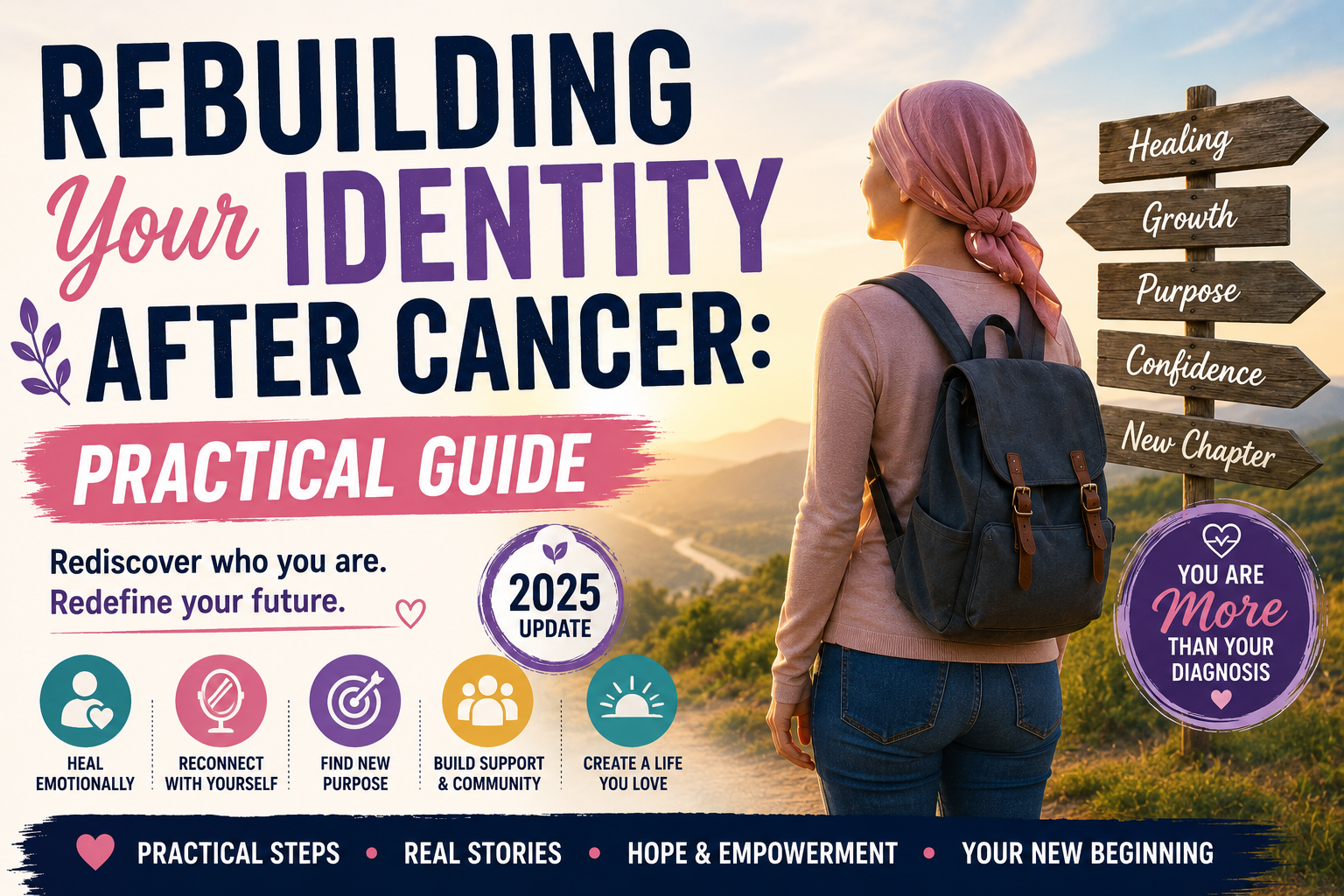
Rebuilding Your Identity After Cancer: Practical Guide
1 in 3 — Cancer survivors who develop clinically significant anxiety or depression post-treatment
80% — Survivors who report cancer changed their sense of self and personal identity
60% — Cancer survivors who report stronger relationships and greater appreciation for life post-treatment
29% — Survivors who report meaningful post-traumatic growth including spiritual or philosophical changes
8 wks — Length of evidence-based Mindfulness-Based Stress Reduction (MBSR) program for survivorship
Who Am I After Cancer?
Cancer doesn’t just affect the body — it transforms identity. The roles you held before (employee, parent, partner, athlete, caregiver), the body you lived in, the plans you carried, the way you related to time and uncertainty — all of these shift during and after cancer treatment. For many survivors, the hardest work isn’t during treatment. It’s after, when the world expects you to ‘be back to normal’ while you’re still figuring out who you are now.
This guide addresses that identity work practically and without minimizing how hard it is.
Understanding the Identity Disruption
Cancer forces a role change most survivors didn’t choose: from healthy person to patient, and then from patient to… what? Many people describe losing the structure and community that came with being a cancer patient. The oncology team that was a constant support suddenly sees you every 3–6 months. The fellow patients in the infusion room may not be there anymore. Even the identity of ‘fighting cancer’ disappears when treatment ends.
Psychologists call this a disruption of ‘narrative identity’ — the story we tell ourselves about who we are. Cancer inserts a major chapter that doesn’t fit neatly into the previous story. The work of survivorship is partly the work of integrating this chapter into a coherent new narrative.
Common Identity Challenges After Cancer
Practical Steps for Identity Rebuilding
Name what changed. Write a list — without judgment — of what is genuinely different now. Your physical capabilities, your fears, your priorities, your relationships. Naming what changed is the first step to working with it rather than fighting it.
Distinguish temporary from permanent changes. Some changes from cancer treatment are temporary (hair loss, certain fatigue). Others may be permanent (surgical changes, some neuropathy). Knowing which is which allows you to stop grieving things that will return and start adapting to things that won’t.
Grieve what was lost. You are allowed to mourn the person you were before cancer, the future you had planned, the body you had. Unexpressed grief doesn’t disappear — it comes out sideways. Working with a therapist experienced in cancer survivorship can structure this grief work safely.
Reconnect with values, not just roles. If your previous identity was built on what you did (your job, your physical capabilities), cancer may have disrupted those foundations. Rebuilding on values — what matters to you rather than what you do — creates a more resilient identity that doesn’t depend entirely on capability or performance.
Post-Traumatic Growth: The Other Side of Trauma
A significant body of research documents post-traumatic growth (PTG) in cancer survivors — positive psychological changes that emerge from the struggle with a significant life challenge. A 2017 study in Psycho-Oncology found that 29–70% of cancer survivors report meaningful PTG, including: greater appreciation for life, deeper relationships, recognition of personal strength, spiritual development, and new possibilities.
PTG doesn’t erase the difficulty of cancer — it coexists with ongoing distress. And not everyone experiences it, which is equally valid. But awareness that growth is possible — and even common — can be meaningful context during survivorship’s hardest days.
| Support Resource | What It Offers | How to Access |
|---|---|---|
| Cancer support groups | Peer connection with others who understand | American Cancer Society, cancer center programs |
| Oncology social worker | Emotional support + practical resources | Request referral from your oncology team |
| Cancer-specialized therapist | Individual CBT or existential work | Psychology Today filter: ‘cancer survivors’ |
| Stupid Cancer (young adults) | Community for AYA (15–39) survivors | stupidcancer.org, online and in-person events |
| MBSR program | Mindfulness-based approach to distress | Palouse Mindfulness (free online 8-week course) |
See: Life After Cancer Treatment: What Nobody Tells You | Managing Cancer Fatigue: 12 Evidence-Based Strategies
Frequently Asked Questions
Is it normal to feel worse emotionally after treatment ends?
Very normal — and very common. During treatment, you’re in ‘battle mode’ with a clear enemy and a structured support system. When treatment ends, the structure disappears, fear of recurrence often intensifies, and the world expects you to be relieved. Many survivors describe the post-treatment period as emotionally harder than treatment itself. If you’re feeling this way, you are not unusual.
How do I talk to people in my life who don’t understand what I’m going through?
Many survivors find that well-meaning people say unhelpful things (‘at least you’re cancer-free now!’) or expect a return to normal that doesn’t yet exist. Strategies: give people specific ways to help rather than general offers; educate close ones about post-treatment fatigue and cognitive changes; set boundaries around cancer-topic conversations when you need a break from it; and find at least one person (therapist, support group, another survivor) who truly understands.
How has cancer changed others’ relationships with me?
Cancer often clarifies relationships. Many survivors find that certain relationships deepen dramatically while others fade — people show you who they are during illness in ways that normal life conceals. Some friends and family members pull away (usually due to their own fear of mortality or helplessness). This is painful but common. The positive counterpart: many survivors find unexpected sources of deep support and connection they didn’t have before.
What is scanxiety and how do I manage it?
Scanxiety is intense anxiety in the days or weeks before cancer follow-up scans. It’s nearly universal among survivors and doesn’t necessarily diminish with time. Effective strategies: time scans strategically (Friday scan = don’t spend the weekend waiting alone), plan positive activities in the scan window, use grounding techniques, limit googling symptoms, and ask your care team to expedite results where possible. Working with a therapist before and during scan periods helps many survivors significantly.
Should I see a therapist after cancer?
Most survivors benefit from at least a few sessions with a therapist experienced in cancer survivorship. You don’t need to be in crisis to benefit — adjusting to survivorship is a significant life transition that therapy is well-suited to support. Look for therapists with oncology or health psychology experience; the American Psychosocial Oncology Society (APOS) has a provider directory.
Is it selfish to focus on my own healing after cancer?
Not at all — it’s essential. Cancer survivorship requires significant physical and emotional resources to navigate well. The cultural pressure on survivors to immediately ‘give back,’ become an advocate, or serve others can be meaningful and also premature. You are allowed to prioritize your own healing for as long as it takes. Purpose and contribution often emerge naturally as recovery deepens — they don’t need to be forced.
Integration, Not Recovery
The goal after cancer isn’t to return to who you were — it’s to integrate the experience into who you are becoming. This takes time, often longer than the culture of cancer survivorship acknowledges. Be patient with yourself, seek support actively, and trust that the disorientation of survivorship, as hard as it is, is also the territory of meaningful growth.